170 stories
·
1 follower

Would The Next George Floyd Video Survive Meta’s New Teen Safety Rules?

2 Shares

Earlier this year, one of the smartest internet rights people around, Heather Burns, suggested the “Darnella Test” regarding any kind of “kid safety” rule online. It’s named after Darnella Frazier. You might not recognize her name, but you’ve seen her work. She was the 17-year-old who was walking to the corner shop when she happened to see Derek Chauvin kneeling on George Floyd’s neck, in the process of murdering him. She got out her phone and filmed it, enabling the world to see that the initial statement from the Minneapolis police — the one headlined “Man Dies After Medical Incident During Police Interaction” — was bullshit.

She won a Pulitzer Prize for the video.

But she was a teen. On social media. So Burns came up with the Darnella test, to explore whether any particular internet regulation would have prevented Darnella from documenting the murder of George Floyd:

For any young person who is just going to be walking along the street for a snack and ends up witnessing something that nobody should ever see because it should not be happening. For that young person whose only recourse, at that moment in time, is to document and report.

And as that future Darnella pulls out their phone to document the event:

  1. Would they be allowed to have that phone, at all, under xyz regulation?
  2. Would they be allowed to have that social media account, at all, under xyz regulation?
  3. Would they be allowed to upload video, or livestream content, under xyz regulation?
  4. Would the video, because of their age-verified account information, be instantly flagged and/or taken down for violent content?
  5. Would the video, as urgent journalistic content in the public interest, be suppressed and censored based not on the content within it but on the age of the person who filmed it?

That’s your Darnella test. Run through it as if your life depends on it. Because it just might.

Thankfully, unlike the various outright bans of social media for teens, the newly announced Meta settlement with most state AGs does not actually ban kids from social media. But that doesn’t mean it passes the Darnella test. At the very least, the settlement will make it much harder for the next Darnella to document and distribute things that need to be documented and distributed.

Let’s start by running the settlement’s terms through the Darnella Test, question by question, to see what a future Darnella would actually be able to do. Especially since the goal of the settlement is that it become the industry norm across all of social media.

The first question doesn’t really apply here, since it has nothing to do with kids having phones directly, so that passes the Darnella test.

You could argue that the second question regarding whether or not the next Darnella would have a social media account also passes, since nothing in the settlement officially bars teens from having an account. But it certainly could impact them indirectly. The age assurance requirements make signing up more of a hassle, so the next Darnella might not bother creating an account at all. And if she does, that verification is precisely what marks her account as a teen account — which is what triggers everything that follows.

We can lump the next three questions together, because they’re all about the content itself. And here is where it seems clear that the settlement agreement fails the Darnella test. The “age-appropriate content restrictions” and the “content restrictions” for teen users would almost certainly create real problems for a teenager documenting a murder like George Floyd’s. A video of a police officer kneeling on a man’s neck until he stops moving is graphic violence by any classifier’s reckoning — and the entire point of a verified teen account is that graphic violence doesn’t stay on it.

And on that last item in the test — whether or not “urgent journalistic content in the public interest” would be suppressed — there are serious problems, even if the video somehow slipped past the content restrictions. The settlement imposes a default two-hour daily time limit on teen accounts — which means the answer might depend on how much time the next Darnella had already burned scrolling before she happened to walk past a murder in progress. Considering that George Floyd was murdered in the evening (around 8:30pm) there’s a good chance a teen user would have already used up their allotted time.

Yes, it’s possible that the next Darnella might have more time due to a parent or guardian bypassing the two hour restriction, but we don’t know that ahead of time. And a teenager watching a man die on the pavement in front of her does not have time to go find a parent and ask them to unlock the app.

Also, crime — and other things worth documenting — doesn’t happen only during your waking hours. The settlement includes “night mode” restrictions that say that teens will not be able to post content between midnight and 6am. If Darnella happened to witness Floyd’s murder past midnight, she might be out of luck. Or, at least, the police would have extra hours to lock in their false narrative.

And this is the problem with so much of the discourse regarding child safety online. It starts from the position that the internet is inherently unsafe for kids, and that the only remaining question is how thoroughly to block them from it.

But reality is more complicated than that. A kid with a phone and a social media account might also be the only thing standing between the official story and the actual truth. A teenager may be the one livestreaming a school shooting from a locked classroom. Or be a bystander filming ICE violating the rights of people across America. They might be the person documenting police violently attacking protestors.

Yet, under a framework built around “protecting teens from the dangerous internet,” such things will face multiple hurdles. A verified minor uploading graphic, unmoderated content in real time will violate all sorts of rules.

Run the actual Darnella video of Derek Chauvin kneeling on George Floyd against the “industry wide” standard Meta just paid $17 billion to create. It doesn’t pass. It’s graphic violence, filmed by a verified teen account late in the evening, perhaps after she’s used up all her allotted time. If it were after midnight she’d be barred entirely from posting. The next Darnella video might not exist. But at least 52 Attorneys General get to pretend they “protected kids.”

Read the whole story
bibismcbryde
6 hours ago
reply
Share this story
Delete

Scientists uncover shared biology behind profound fatigue in five major illnesses | EurekAlert!

2 Shares

A shared biological secret that helps explain chronic exhaustion in conditions including long Covid and PTSD has been discovered by researchers at the University of East Anglia and Oxford BioDynamics.

A new paper published today in the Journal of Translational Medicine reveals striking biological similarities between five major illnesses which until now have largely been viewed as separate disorders.

The findings suggest that chronic fatigue syndrome (also known as ME), long Covid, post-traumatic stress disorder (PTSD), rheumatoid arthritis and multiple sclerosis (MS) may be driven by common underlying mechanisms.

This is despite the conditions being triggered by different events - ranging from viral infections to psychological trauma or autoimmune responses.

Lead researcher Prof Dmitry Pshezhetskiy, from UEA’s Norwich Medical School, said: “Until now, illnesses including long Covid, PTSD, ME/CFS, multiple sclerosis and rheumatoid arthritis were viewed as seemingly unrelated and triggered by completely different events.

“ME/CFS often follows viral infection. Long Covid develops after SARS-CoV-2 infection. PTSD emerges after traumatic experiences. Rheumatoid arthritis is an autoimmune disease attacking the joints, while multiple sclerosis attacks the nervous system.

“But one thing that links them all is that patients frequently report remarkably similar symptoms - overwhelming fatigue, brain fog, poor concentration, disturbed sleep, autonomic dysfunction and a dramatic reduction in everyday functioning.

“We wanted to find out why this is.

“What we discovered is something approaching a biological unifying theory of fatigue.”

How the research happened

Rather than conventionally analysing DNA sequences, researchers from UEA used Oxford BioDynamics' innovative EpiSwitch® Orion platform, which examines the three-dimensional architecture of the genome, essentially studying how DNA folds and interacts inside living cells.

The analysis was computational. Published genomic data for long Covid, PTSD, rheumatoid arthritis and multiple sclerosis, drawn from existing genome-wide association studies, were combined with 3D genomic data from an earlier ME/CFS patient study, without needing to collect new patient samples.

“DNA is folded in our cells, so regions far apart in the linear sequence can touch, and those contact points are where genes get controlled. Orion predicts where these contact points are likely to be,” said Dr Ewan Hunter, Chief Data Officer at Oxford BioDynamics.

Applied to the five conditions, Orion found that genetic changes, that appeared to have little in common, connected into the same regulatory circuitry.

Prof Pshezhetskiy said: “We expected to find at least some overlap in genes across the conditions. But we actually found the opposite.

“At an individual gene level, there was surprisingly little direct overlap between ong Covid, ME/CFS, PTSD, multiple sclerosis and rheumatoid arthritis.

“But when we analysed how those genes interact in complex biological networks, a completely different picture emerged. Suddenly, the diseases appeared deeply connected.

“This is not something you can see by reading the genetic sequence alone, which is why these conditions may have looked unrelated for so long.

“Although these conditions are triggered by completely different events, they may ultimately disrupt the same fundamental biological systems and produce the similarly devastating exhaustion experienced by millions worldwide.”

The study found that genes linked to each illness were feeding into the same major biological systems - including immune and inflammatory signalling, mitochondrial energy production, metabolic regulation, stress-response mechanisms and neuroendocrine signalling.

Why trauma and viruses can produce the same symptoms

The team say the study could help explain why people who have experienced a viral infection or psychological trauma can go on to develop similar symptoms.

“We now think the answer may lie in shared regulatory networks embedded within the body's immune and metabolic systems,” said Prof Pshezhetskiy.

“A Covid infection may trigger prolonged immune activation. Traumatic stress may disrupt stress-hormone pathways and inflammatory responses.

“But both disturbances appear capable of converging on common biological circuits controlling energy production, immune regulation and cellular resilience.

“When those systems become persistently dysregulated, the result may be the profound and disabling fatigue seen across multiple disorders.”

A new role for the immune system

The study also highlighted several ‘hub genes’ that sit at the busiest points within these shared networks.

Among them were genes involved in immune regulation, inflammatory signalling and mitochondrial energy production. The authors stress that these are candidates identified by the analysis, and more work is needed to confirm what role they play.

One part of the analysis, looking specifically at ME/CFS, flagged LAG3 as a gene to investigate. This is a molecule associated with ‘T-cell exhaustion’, a state in which immune cells become worn out after prolonged activation.

The team say that if this can be confirmed in further studies, it could help explain why many patients appear stuck in a state of chronic illness long after the original trigger has disappeared.

“This work adds to a growing body of evidence suggesting that persistent immune dysfunction may play a far larger role in chronic fatigue-related illnesses than previously recognised,” said Prof Pshezhetskiy.

Paving the way for blood tests and treatments

“Perhaps the most significant implication is what this could mean for diagnosis.

“ME/CFS and long Covid are currently diagnosed largely through symptoms, with no universally accepted laboratory test available.

“That has left many patients facing years of uncertainty.”

Separate earlier work using the EpiSwitch platform had already produced a blood-based ME/CFS test promising high levels of diagnostic accuracy, ready to be taken through further validation needed for clinical use.

The new findings raise the prospect of signatures shared across several conditions, beyond only ME/CFS.

“We hope our work could pave the way for objective blood tests capable of identifying underlying biological signatures rather than relying solely on patient-reported symptoms,” said Prof Pshezhetskiy.

Now, the team hope the newly identified shared biological pathways could eventually lead to broader diagnostic tools and even treatments that work across several chronic conditions.

“Rather than viewing long Covid, ME/CFS, PTSD, rheumatoid arthritis and multiple sclerosis as entirely separate disorders, we now think they may be different manifestations of disturbed biological networks operating throughout the body.

“In that scenario, chronic exhaustion is not simply a symptom. It is the visible consequence of a deeper systems failure affecting immune function, metabolism and stress-response pathways.

“This study offers a framework for understanding how different triggers can converge to cause the exact same profound clinical exhaustion.”

This research was led by the University of East Anglia in collaboration with Oxford BioDynamics, the London School of Hygiene and Tropical Medicine, and Cornwall Partnership NHS Foundation Trust.

‘Beyond Genes: EpiSwitch® and Orion Platform-powered 3D Genome Architecture Biomarkers Reveal Shared Biology Across ME/CFS, Long COVID, PTSD, Rheumatoid Arthritis, and Multiple Sclerosis’ is published in the Journal of Translational Medicine.

ENDS


Disclaimer: AAAS and EurekAlert! are not responsible for the accuracy of news releases posted to EurekAlert! by contributing institutions or for the use of any information through the EurekAlert system.

Read the whole story
bibismcbryde
2 days ago
reply
Share this story
Delete

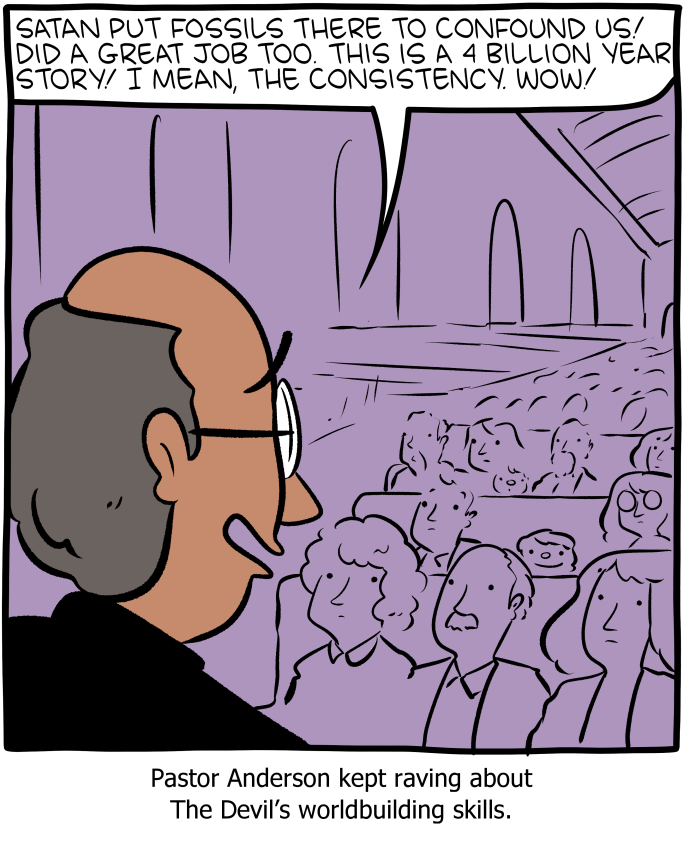
Saturday Morning Breakfast Cereal - Satan

1 Comment and 2 Shares


Click here to go see the bonus panel!

Hovertext:
And look where he put the anus. I mean it's right in the middle of the action. This guy is brilliant!


Today's News:
Read the whole story
bibismcbryde
6 days ago
reply
Share this story
Delete
1 public comment
jlvanderzwan
9 days ago
reply
Hey, if you interpret Satan as not evil but just out there to test us (see: Book of Job), then it seems quite reasonable to respect them for doing an impressive job. Also, now I'm imaginening God calling them in for their eonly performance review and going "btw, love what you did with the birds are dinosaurs bit, so creative! How do you come up with these things? Rhetorical question ofc, omniscient."

Hurry

1 Share
Read the whole story
bibismcbryde
75 days ago
reply
Share this story
Delete

Carolyn Hax: Involved grandpa steals spotlight from out-of-town in-laws

1 Share
Letter writer thinks 3-year-old daughter’s attachment to father-in-law is hurting his parents’ feelings.
Read the whole story
bibismcbryde
230 days ago
reply
Share this story
Delete

https://webcomicname.com/post/793150830904737792

1 Share
Read the whole story
bibismcbryde
372 days ago
reply
Share this story
Delete
Next Page of Stories